
Jun 26, 2026
Why Bumper Blocks Are the Unsung Heroes of Your Loading Dock
Introduction Walk onto any busy loading dock, and you’ll see them. Mounted on the dock face, often overlooked, frequently forgotten. Bumper blocks. They don’t have motors. They don’t need electricity.
Introduction
Walk onto any busy loading dock, and you’ll see them. Mounted on the dock face, often overlooked, frequently forgotten.
Bumper blocks.
They don’t have motors. They don’t need electricity. They don’t make headlines.
But every day, they absorb impact after impact — protecting your dock, your vehicles, and your bottom line.
In this article, we’ll explore why bumper blocks matter, what makes a quality bumper block, and how the right choice can save your facility thousands in repair and downtime costs.
The Hidden Cost of Dock Impacts
Every time a truck backs into a loading dock, force is transferred. Without proper protection, that force goes straight into:
• The dock structure — cracked concrete, damaged steel, misaligned dock levelers
• The vehicle — damaged trailers, bent frames, costly repairs
• The equipment — forklifts and operators working around unstable dock conditions
Over time, these impacts add up. A facility with 50 truck arrivals per day, 250 days per year, experiences 12,500 impacts annually. Each impact stresses your dock infrastructure.
The result? Accelerated wear, unexpected failures, and escalating maintenance costs.
What Makes a Quality Bumper Block?
Not all bumper blocks are created equal. The difference between a block that lasts five years and one that lasts fifteen years comes down to three factors:
- Material The best bumper blocks are made from vulcanized rubber. This process transforms raw rubber into a material that is: • High elasticity — compresses under impact, returns to shape • Wear-resistant — withstands repeated friction and abrasion • Aging-resistant — maintains performance even after years of exposure
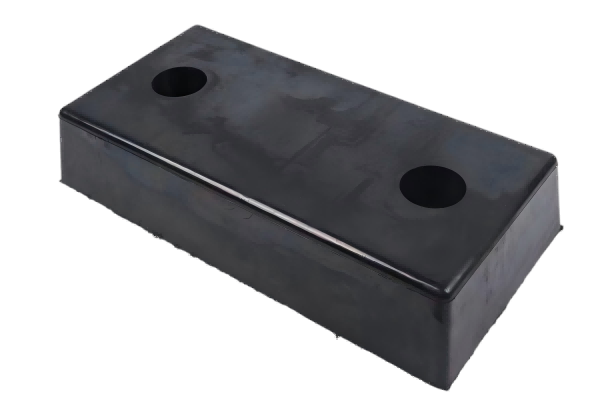
- Size and Coverage A bumper block that’s too small concentrates impact forces on a smaller area, increasing stress on both the dock and the trailer. The GEAJIE bumper block is sized at: • Width: 200 mm • Length: 300 mm • Thickness: 100 mm This provides optimal coverage for standard dock applications, distributing impact forces evenly and protecting the full contact area.
- Construction Quality
Look for:
• Uniform density — consistent performance across the entire block
• Reinforced mounting — secure attachment to the dock face
• Weather resistance — performance in extreme temperatures and weather conditions
📊 The ROI of Quality Bumper Blocks
Let’s look at the numbers.
Facility profile:
• 4 loading docks
• 50 truck arrivals per day
• 250 operating days per year
Cost Category
Low-Quality Bumpers (Replace every 2 years)
GEAJIE Bumpers (Replace every 8–10 years)
Bumper replacement cost (10 years)
800 Dock repair cost (cracks, damage)1,500 Trailer damage claims1,000 Total 10-year cost3,300 10-year savings with GEAJIE:3,2002,500 $600 76% reduction Unplanned downtime (hours/year) 18 hours 4 hours 78% reduction “We used to treat bumper blocks as disposable. After switching to GEAJIE, we realized that quality bumpers aren’t an expense — they’re an investment that pays for itself in avoided damage.” — Distribution Center Manager When to Replace Your Bumper Blocks Even the best bumper blocks have a service life. Here are signs it’s time to replace: 🔴 Visible cracking or splitting — rubber is losing elasticity 🔴 Permanent compression — block no longer returns to original shape 🔴 Missing chunks — impact has torn away material 🔴 Loose mounting — bolts are pulling through or block is shifting 🔴 Dock damage — you’re seeing cracks or wear on the dock face itself If you’re seeing any of these signs, it’s time for an upgrade. Choosing the Right Bumper Block for Your Facility Standard Applications For most warehouses and distribution centers, the 200×300×100mm vulcanized rubber bumper block provides optimal protection. Heavy-Duty Applications For facilities with: • Extremely high truck traffic (100+ arrivals/day) • Heavy vehicles (loaded trucks over 80,000 lbs) • Harsh environmental conditions Consider reinforced mounting systems or larger coverage areas. Cold Storage / Freezer Applications Vulcanized rubber maintains elasticity even in sub-zero temperatures, making it ideal for cold storage facilities where standard rubber can become brittle. Final Thoughts Bumper blocks may be small, but their impact on your operation is anything but. They protect your infrastructure, your vehicles, and your bottom line — quietly absorbing thousands of impacts every year. Choosing quality matters. A vulcanized rubber bumper block from GEAJIE delivers: • Longer service life — 8–10 years vs. 2 years for low-quality alternatives • Superior protection — reduces dock and trailer damage • Lower total cost — fewer replacements, fewer repairs, less downtime Don’t overlook the unsung heroes of your loading dock. Invest in quality. Invest in GEAJIE. About GEAJIE GEAJIE is a leading manufacturer of industrial dock equipment, including high-quality vulcanized rubber bumper blocks, dock levelers, and high-speed industrial doors. We help warehouses, distribution centers, and manufacturing facilities operate safely and efficiently.