
Jun 26, 2026
How High-Speed Industrial Doors Reduce Energy Costs in Warehouses
Introduction When warehouse managers think about energy costs, they usually focus on the usual suspects: lighting, HVAC systems, insulation. But there’s one area that often goes overlooked — yet it ca
Introduction
When warehouse managers think about energy costs, they usually focus on the usual suspects: lighting, HVAC systems, insulation. But there’s one area that often goes overlooked — yet it can account for up to 30% of a facility’s energy loss.
The loading dock door.
Every time a door opens, conditioned air escapes. Every second it stays open, energy dollars disappear. And if the door has poor seals or operates slowly, the problem compounds — cycle after cycle, day after day.
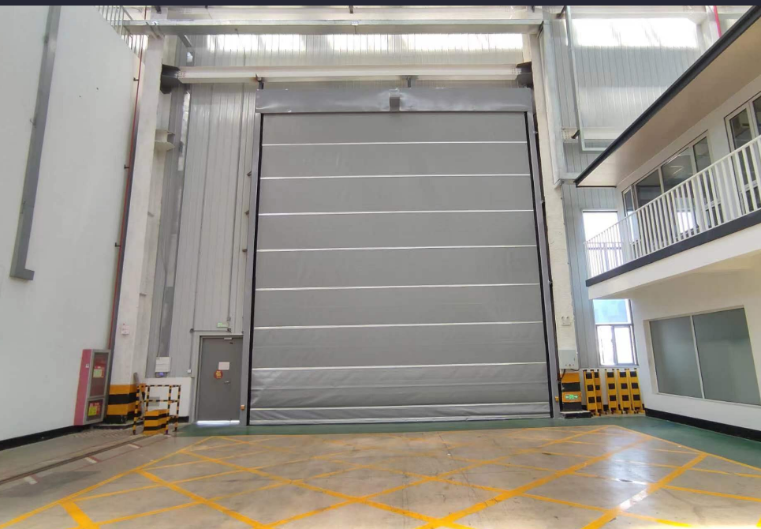
In this article, we’ll explore how high-speed industrial doors — specifically GEAJIE accumulation doors — can significantly reduce energy waste, lower utility bills, and improve overall warehouse efficiency.
The Hidden Cost of Door Openings
Let’s start with a simple question:
How many times does your loading dock door open each day?
For many warehouses, the answer is 100, 200, even 300 times per day. Each opening creates an opportunity for air exchange — and with it, energy loss.
Consider this scenario:
• A standard sectional door takes 30–60 seconds to open and close
• Each cycle allows a significant volume of conditioned air to escape
• In climate-controlled warehouses, that means:
◦ Cooling loss in summer
◦ Heating loss in winter
◦ Humidity fluctuations affecting product quality
Now multiply that by hundreds of cycles per day, 20+ days per month, 12 months per year.
The cumulative cost is staggering — and entirely preventable.
The Science: How Air Exchange Impacts Energy Bills
When a door opens, the pressure difference between inside and outside forces air to move. Warm air rises; cold air sinks. In a warehouse with climate control, this natural convection accelerates every time the door is open.
Factors that determine energy loss:
Factor
Impact
Door speed
Slower doors = more time for air exchange
Opening frequency
More cycles = multiplied loss
Seal quality
Poor seals = constant leakage even when closed
Temperature difference
Greater ΔT = faster energy loss
A slow, poorly sealed door doesn’t just waste energy during operation — it leaks continuously, even when “closed.”
How High-Speed Industrial Doors Solve the Problem
High-speed industrial doors are engineered specifically to minimize energy loss. Unlike traditional doors, they address every factor that contributes to air exchange.
✅ 1. Fast Operation Minimizes Air Exchange
GEAJIE high-speed accumulation doors operate in 3–5 seconds per cycle — up to 10x faster than traditional sectional doors.
Example:
If a door opens 200 times per day:
• Traditional door (40 sec/cycle): 8,000 seconds of open time per day
• GEAJIE door (4 sec/cycle): 800 seconds of open time per day
That’s 90% less time for conditioned air to escape.
✅ 2. Tight Seals Prevent Continuous Leakage
Even when closed, many traditional doors allow air to escape through gaps at the sides, top, and bottom.
GEAJIE doors feature:
• Double-sealed side guides for a tight fit
• Bottom brush or air seals to block drafts
• Insulated curtain options for temperature-sensitive environments
✅ 3. Durable Construction Maintains Performance
A door that breaks down frequently doesn’t just cause downtime — it also wastes energy while waiting for repairs. GEAJIE doors are built for high-frequency use, with minimal maintenance requirements and long service life.
📊 Data: The Energy Savings Impact
Let’s look at the numbers.
Warehouse profile:
• 4 loading dock doors
• 200 cycles per day per door
• Climate-controlled (cooling in summer, heating in winter)
Door Type
Cycle Time
Annual Energy Cost (HVAC)
Standard sectional door
40 sec
17,800
Annual energy savings: 67,000
9,200
$2,800
70% reduction
“The doors were the weak link in our cold chain. After switching to GEAJIE, we finally have consistent temperature control — and the energy savings paid for the doors in 14 months.”
— Facility Manager, Food Distributor
Beyond Energy: Additional Benefits of High-Speed Doors
While energy savings alone often justify the investment, high-speed doors deliver additional value:
• Increased throughput — faster door cycles mean more truck turns per day
• Improved worker comfort — consistent temperature means happier, more productive employees
• Enhanced safety — faster operation reduces wait times and congestion at the dock
• Lower maintenance costs — durable design means fewer repairs and less downtime
When Should You Consider Upgrading?
If any of the following apply to your facility, a high-speed industrial door can deliver significant energy savings:
• You operate a climate-controlled warehouse (cold storage, food, pharmaceutical)
• Your loading dock sees 100+ cycles per day
• You’ve noticed temperature fluctuations near dock areas
• Your energy bills have been steadily increasing
• Your current doors are more than 10 years old
Final Thoughts
In the quest for warehouse efficiency, energy costs often fly under the radar. But the reality is simple: every time your door opens, money escapes.
High-speed industrial doors — like those from GEAJIE — are one of the most effective tools for stopping that leakage. By minimizing air exchange, maintaining tight seals, and operating at high speed, they deliver measurable energy savings, fast ROI, and lasting performance.
If you’re ready to stop letting energy escape through your loading dock, it’s time to take a closer look at your doors.
About GEAJIE
GEAJIE is a leading manufacturer of high-speed accumulation doors, serving warehouses, distribution centers, cold storage facilities, and manufacturing plants worldwide. Our doors are engineered for speed, durability, and energy efficiency — helping you reduce costs and improve operations.